
As a provider of automatic soldering machines, ensuring the soldering consistency of our equipment is of utmost importance. Soldering consistency directly affects the quality and reliability of the products manufactured using our machines. In this blog post, I will share some key strategies and considerations to ensure the soldering consistency of an automatic soldering machine.
Understanding the Basics of Soldering Consistency
Soldering consistency refers to the ability of a soldering machine to produce uniform and reliable solder joints across multiple soldering operations. Consistent soldering is crucial for maintaining product quality, reducing defects, and ensuring the long - term performance of electronic devices. Several factors can influence soldering consistency, including temperature control, solder material, soldering time, and machine calibration.
Temperature Control
One of the most critical factors in soldering consistency is temperature control. The soldering iron or heating element must reach and maintain the appropriate temperature throughout the soldering process. Different solder materials have different melting points, and the soldering temperature should be set according to the specific requirements of the solder being used.
- Precise Temperature Sensors: Our automatic soldering machines are equipped with high - precision temperature sensors. These sensors continuously monitor the temperature of the soldering tip and send feedback to the control system. The control system can then adjust the power supply to the heating element to maintain a stable temperature. For example, if the temperature drops below the set point, the control system will increase the power to the heating element to bring the temperature back up.
- Temperature Profiling: Another important aspect of temperature control is temperature profiling. Different soldering applications may require different temperature profiles. For instance, in some cases, a pre - heating stage may be necessary to gradually raise the temperature of the components being soldered to prevent thermal shock. Our machines allow users to program custom temperature profiles based on their specific soldering requirements.
Solder Material
The choice of solder material also plays a significant role in soldering consistency. Different solder alloys have different properties, such as melting point, wetting ability, and mechanical strength.

- High - Quality Solder: We recommend using high - quality solder materials from reputable suppliers. High - quality solder has a more consistent composition, which ensures more uniform melting and wetting during the soldering process. For example, lead - free solder alloys, which are widely used in the electronics industry due to environmental regulations, require careful selection to ensure good soldering performance.
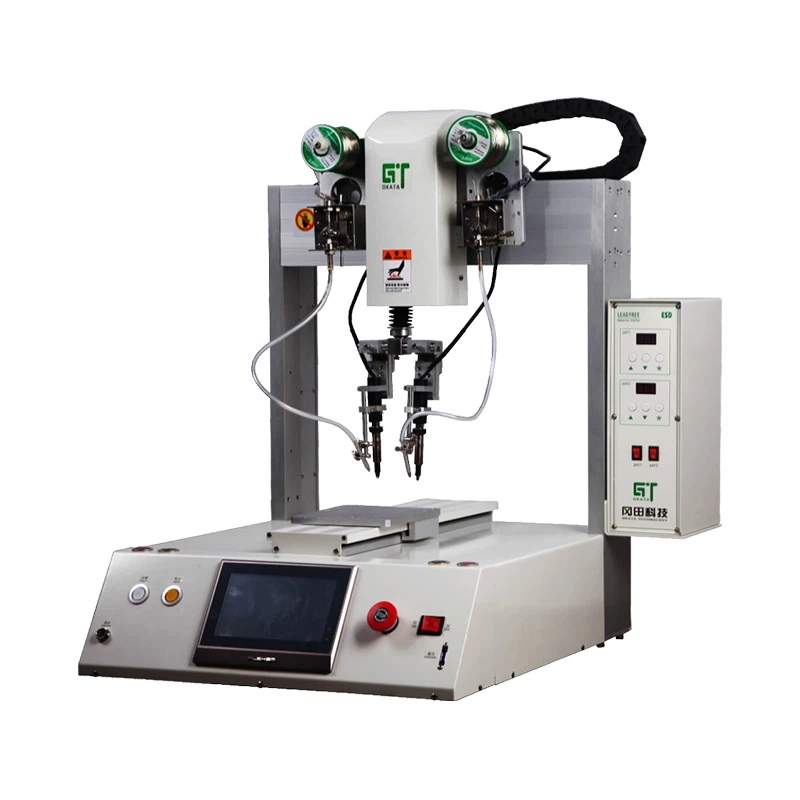
- Solder Feed System: Our automatic soldering machines are equipped with advanced solder feed systems. These systems precisely control the amount of solder being fed to the soldering joint. The solder feed rate can be adjusted according to the size and type of the soldering joint. A consistent solder feed rate helps to ensure that each soldering joint receives the right amount of solder, which is essential for consistent soldering quality.
Soldering Time
The duration of the soldering process, or soldering time, is another factor that affects soldering consistency. If the soldering time is too short, the solder may not fully melt or wet the surfaces being joined, resulting in a weak or unreliable joint. On the other hand, if the soldering time is too long, it can cause overheating of the components and damage to the printed circuit board (PCB).
- Programmable Soldering Time: Our machines allow users to program the soldering time for each soldering operation. The soldering time can be adjusted based on the size and complexity of the soldering joint, as well as the type of solder and components being used. By precisely controlling the soldering time, we can ensure that each soldering joint is formed under optimal conditions.
- Real - Time Monitoring: In addition to programming the soldering time, our machines also have real - time monitoring capabilities. The control system can detect if the soldering process is taking longer or shorter than the programmed time and take appropriate actions. For example, if the soldering time exceeds the set limit, the machine can automatically stop the soldering process to prevent damage to the components.
Machine Calibration
Regular machine calibration is essential for maintaining soldering consistency. Over time, the components of the soldering machine may wear out or become misaligned, which can affect the accuracy of the soldering process.
- Periodic Calibration Checks: We recommend that our customers perform periodic calibration checks on their automatic soldering machines. This includes checking the alignment of the soldering head, the accuracy of the temperature sensors, and the performance of the solder feed system. Our technical support team can provide detailed calibration instructions and assistance to ensure that the machines are calibrated correctly.
- Calibration Tools: We also offer a range of calibration tools to help our customers perform accurate calibration. These tools are designed to measure and adjust various parameters of the soldering machine, such as temperature, solder feed rate, and soldering head position.
Quality Control and Inspection
In addition to the above factors, implementing a comprehensive quality control and inspection process is crucial for ensuring soldering consistency.
- In - Process Inspection: Our automatic soldering machines can be integrated with in - process inspection systems. These systems use sensors and cameras to inspect the soldering joints during the soldering process. For example, a vision system can detect if the solder joint has the correct shape, size, and wetting angle. If a defect is detected, the machine can automatically stop the soldering process and alert the operator.
- Post - Process Inspection: After the soldering process is completed, a post - process inspection should be carried out. This can include visual inspection, X - ray inspection, and electrical testing. Visual inspection can detect obvious defects such as solder bridges, insufficient solder, or misaligned components. X - ray inspection can be used to detect internal defects such as voids in the solder joint. Electrical testing can verify the functionality of the soldered components.
Training and Support
Finally, providing proper training and support to our customers is essential for ensuring soldering consistency.
- Operator Training: We offer comprehensive operator training programs for our automatic soldering machines. These programs cover topics such as machine operation, programming, maintenance, and troubleshooting. By ensuring that the operators are well - trained, we can minimize the risk of human error and ensure that the machines are used correctly.
- Technical Support: Our technical support team is available 24/7 to provide assistance to our customers. Whether it's a technical problem with the machine or a question about soldering parameters, our team can provide timely and effective solutions.
Conclusion
Ensuring the soldering consistency of an automatic soldering machine requires a comprehensive approach that includes temperature control, solder material selection, soldering time management, machine calibration, quality control, and operator training. As a leading provider of Automatic Soldering Machine, we are committed to providing high - quality machines and excellent support to our customers. Our Online Automatic Soldering Machine and Laser Soldering Machine for Electronic Instruments are designed with the latest technology to ensure the highest level of soldering consistency.
If you are interested in our automatic soldering machines or have any questions about soldering consistency, please feel free to contact us for a detailed consultation and procurement negotiation. We look forward to working with you to improve your soldering processes and product quality.
References
- "Soldering Technology Handbook", published by a well - known industry publisher.
- Research papers on soldering process optimization from leading academic journals.